

If you’ve been shopping for a home in Austin, there’s a good chance you’ve already seen FEMA flood zone information pop up on a listing. And if the catastrophic flooding that swept through Central Texas in July 2025 taught us anything, it’s that flood risk in this region is not something to skim past in the disclosure documents.
That flooding event brought the equivalent of four months of rain to the Texas Hill Country in just a few hours, killing more than 137 people and causing over $1.1 billion in damage across the region. The Guadalupe River rose approximately 26 feet in 45 minutes at Hunt. It was also a stark reminder that Central Texas geography and weather patterns create real flood risk for home buyers, including in parts of Austin that don’t look like typical flood zones on a map.
This guide covers everything you need to know before making an offer on a home in or near an Austin flood zone: what the FEMA designations actually mean, which Austin neighborhoods have the highest risk, how much flood insurance costs, what sellers must disclose by law, and how to make a smart decision with full information.
Why Austin Flood Zones Matter More Than Ever
Austin's flood risk picture has changed significantly over the past several years, and it's still changing.
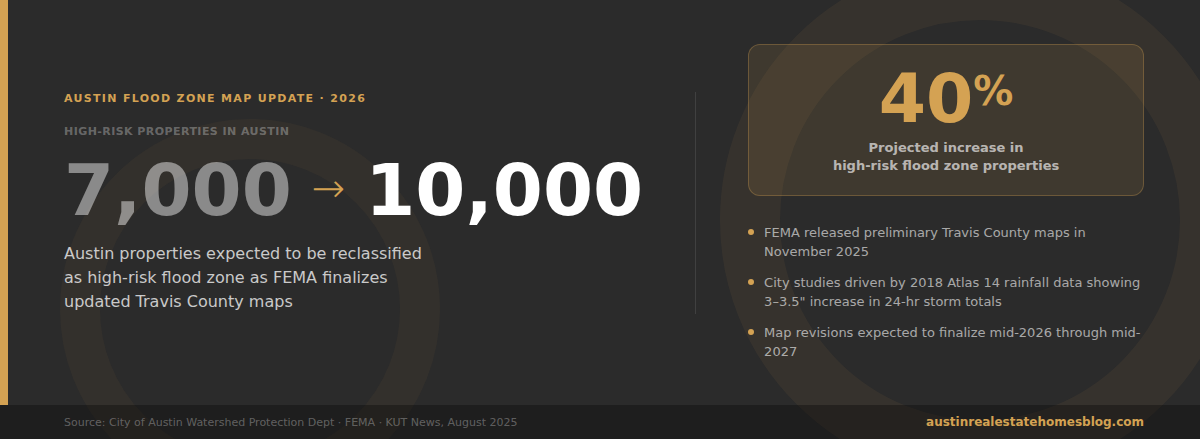
In 2018, NOAA incorporated an additional 25 years of rainfall data into updated weather records -- a study known as Atlas 14. What it revealed was striking: the 24-hour rainfall totals for a 1% annual chance storm had increased by roughly 3 to 3.5 inches across Travis County compared to previous calculations. In practical terms, severe storms hit this area more frequently and with more intensity than older flood maps accounted for.
As a result, the City of Austin began conducting its own updated floodplain studies, and FEMA released preliminary revised flood maps for Travis County in November 2025. The city's studies are expected to complete by mid-2026, with results submitted to FEMA for national map revision afterward. When those updates are finalized, the number of Austin properties classified as high-risk is expected to climb from roughly 7,000 to around 10,000 -- close to a 40 percent increase.
If you're buying today, you may be purchasing in an area that could be reclassified before your first mortgage anniversary. That matters both for your insurance costs and for your long-term investment outlook.
Understanding Austin's Flood Zone Designations
FEMA assigns flood zone designations to every parcel in the country. Here's what each designation means for properties in the Austin area.
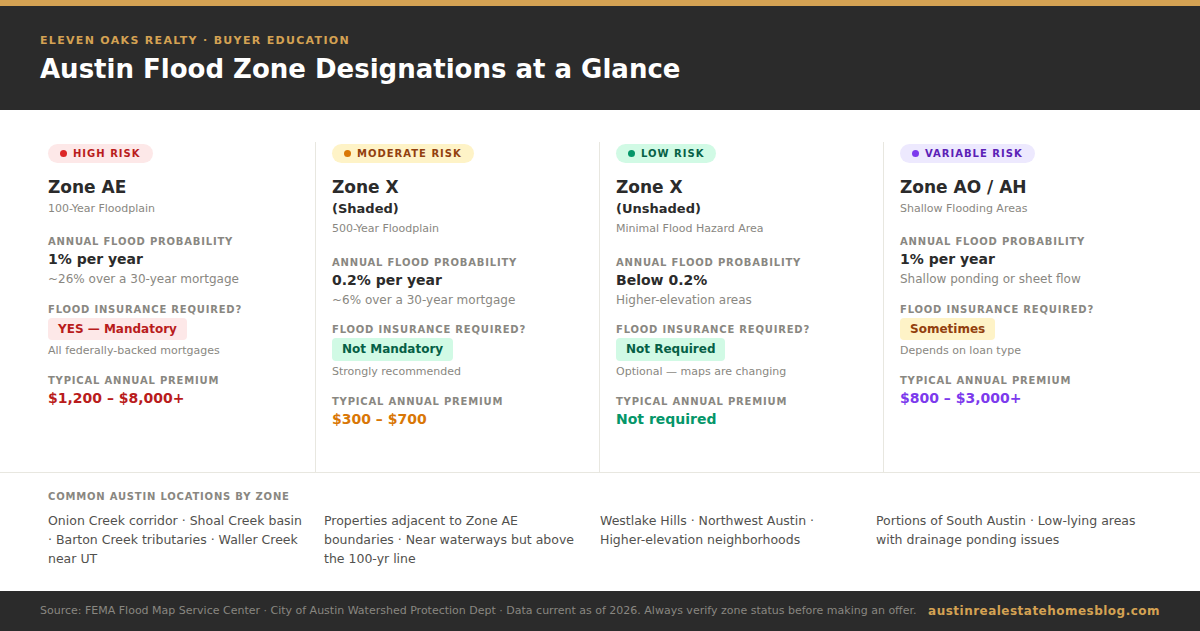
Zone AE is the high-risk designation, representing the 100-year floodplain -- an area with a 1% annual chance of flooding. Over a 30-year mortgage, that translates to roughly a 26% cumulative chance of experiencing at least one flood event. If you're obtaining a federally-backed mortgage on a Zone AE property, flood insurance is mandatory. This is not optional.
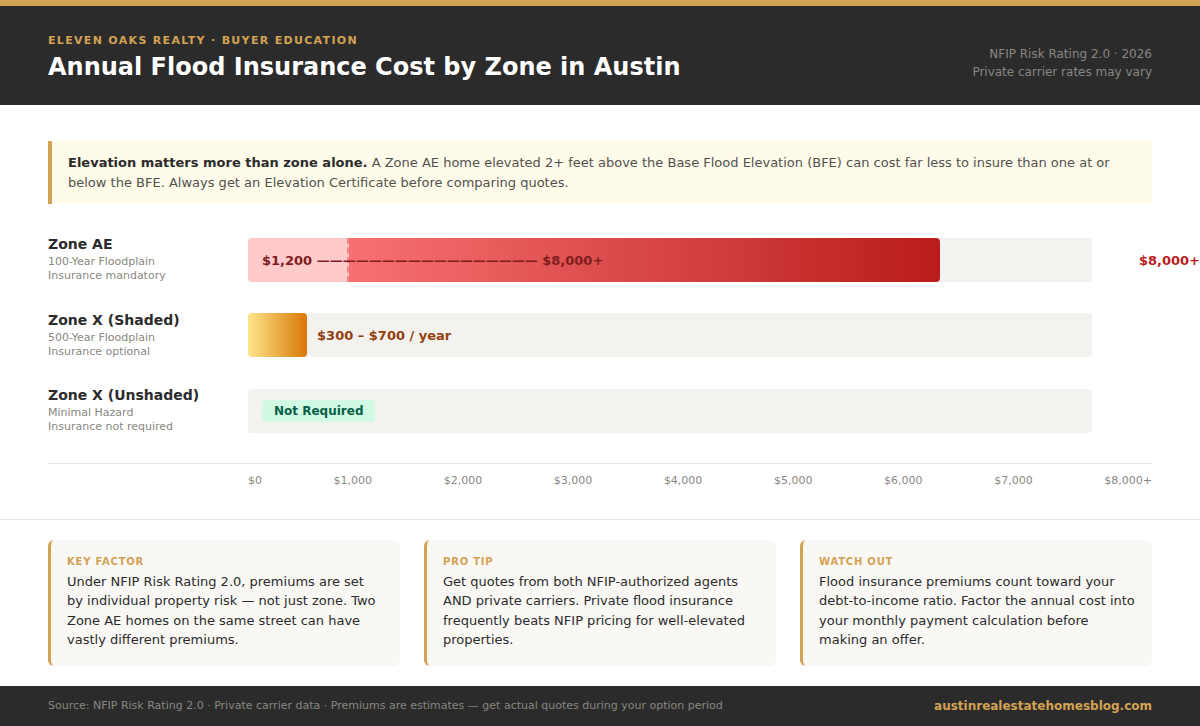
Zone X (Shaded), sometimes called the 500-year floodplain, indicates a 0.2% annual flood risk. Flood insurance is not required here, but it's worth serious consideration. Premiums for Zone X properties typically run $300 to $700 per year through private insurers.
Zone X (Unshaded) represents minimal flood risk, generally found in higher-elevation areas of Austin. Flood insurance is neither required nor typically recommended here, though some buyers opt for it given how actively Austin's maps are being updated.
Zone AO and Zone AH apply to areas with shallow ponding or sheet-flow flooding, common in parts of South Austin. Zone AO properties flood to predictable depths; Zone AH properties flood to specific elevations. Both designations carry elevated risk and may require flood insurance depending on your loan type.
Which Austin Neighborhoods Carry the Highest Flood Risk?
Flood risk in Austin follows the waterways. The neighborhoods with the most significant exposure are concentrated along Austin's major creeks and rivers.
The Onion Creek corridor, covering parts of ZIP codes 78748 and 78739 in South Austin, has the most documented flood history in the city. The 2013 Onion Creek flood was one of Austin's worst on record, prompting FEMA to fund a buyout program that removed more than 800 homes from the floodplain. Properties that remain in this corridor carry meaningful and well-documented risk.
The Shoal Creek basin runs through Central Austin neighborhoods including Hyde Park and Brentwood. Shoal Creek has flooded repeatedly over the decades, and portions of these neighborhoods sit within or adjacent to the Zone AE boundary.
Waller Creek cuts through the area near the UT campus and into East Austin. Urban development along Waller Creek has intensified runoff over the years, and some stretches remain in high-risk zones despite ongoing city mitigation projects.
Barton Creek and its tributaries affect parts of Southwest Austin, including some well-established neighborhoods west of MoPac. The Barton Creek watershed drains a large area, and tributaries can rise quickly during heavy rain events.
On the lower-risk end of the spectrum, Westlake Hills and many parts of Northwest Austin benefit from higher elevation and sit primarily in Zone X. That said, local conditions vary block by block, and individual properties in these areas can still carry localized drainage issues that don't appear on FEMA maps.
How to Find Out If a Home Is in a Flood Zone
Several tools can help you research flood zone status before making an offer, and it's worth using more than one.
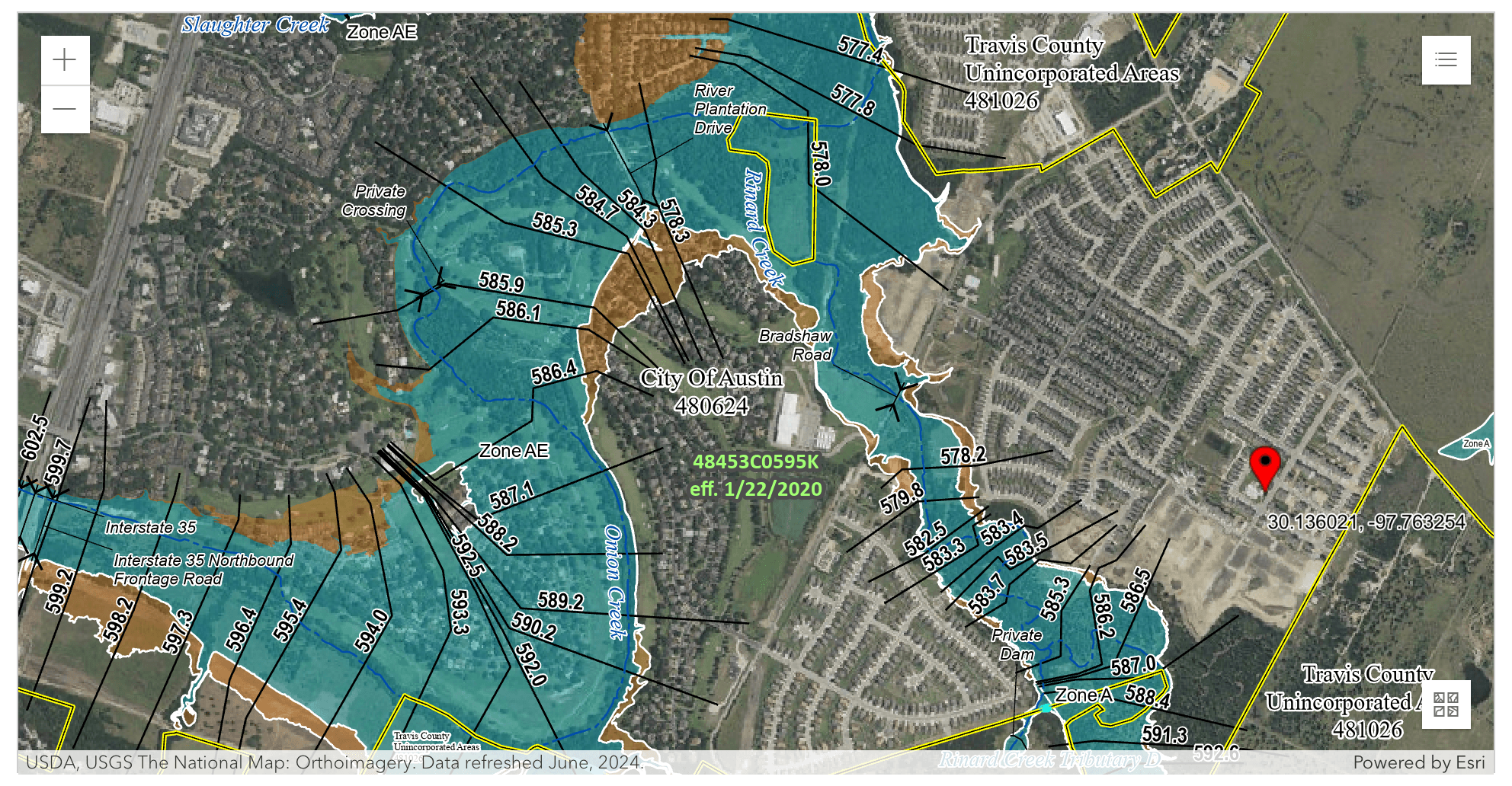
The FEMA Flood Map Service Center at msc.fema.gov lets you search any address and view its current FEMA designation. This is the official federal resource, though some Austin maps haven't been updated in a decade or more.
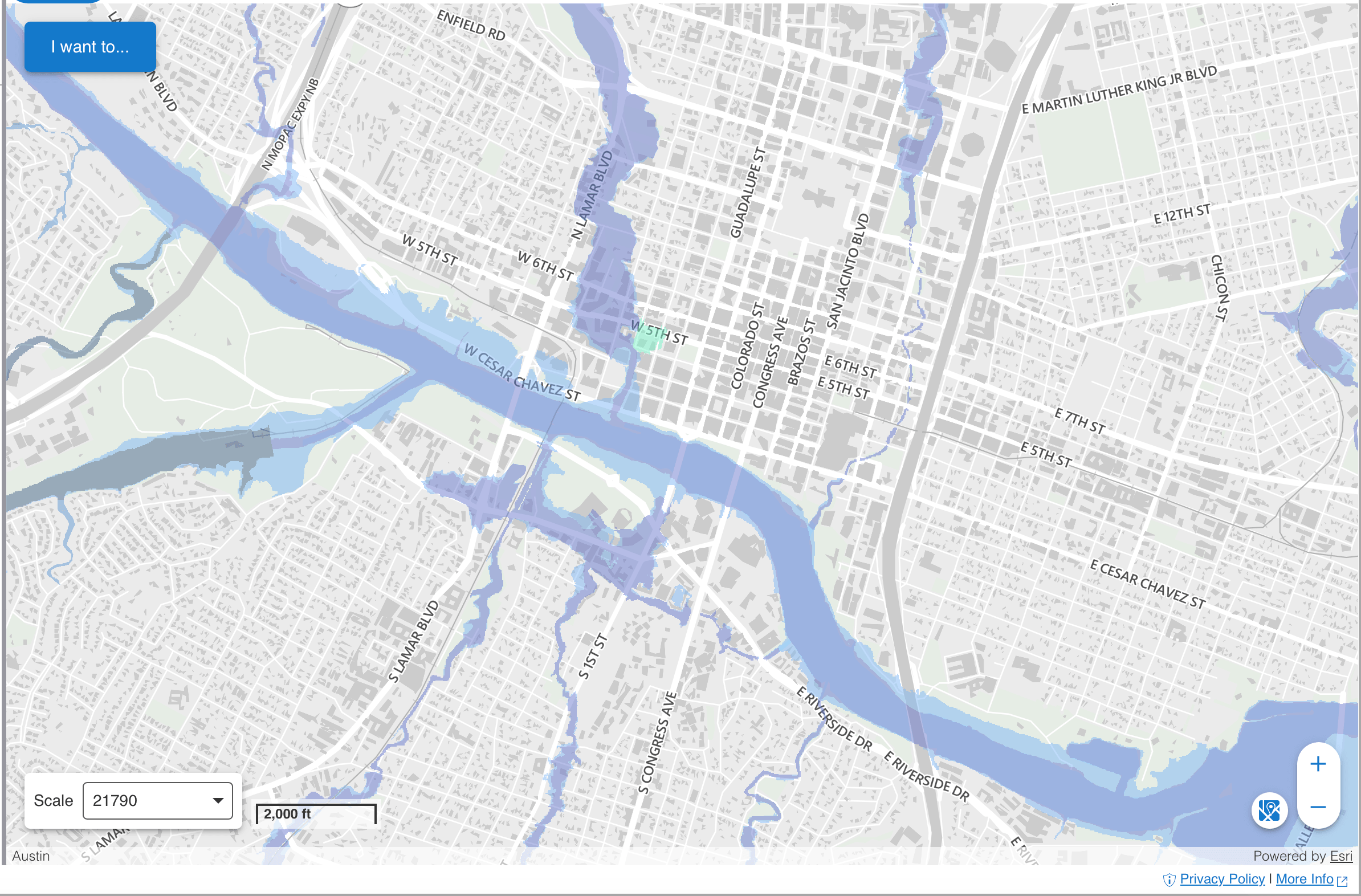
The Austin Flood Explorer is maintained by the City of Austin's Watershed Protection Department and often reflects more current risk data than the federal maps, since the city conducts its own studies and flags areas currently under active re-study.
The City of Austin Watershed Protection Department itself is the most direct resource for specific property questions, particularly if a parcel is in or near a re-study area. Staff can tell you whether a property's flood zone designation is currently under review.
One thing worth understanding: a FEMA map search tells you what zone a property is currently designated, not what it may be reclassified as when the updated Travis County maps take effect. Given the scale of the current revision, it's worth asking your agent and a flood insurance specialist about re-study risk for any property you're seriously considering.
What Texas Law Requires Sellers to Disclose
Under Texas Senate Bill 339, which took effect in September 2019, sellers must disclose more flood-related information than ever before. Specifically, sellers are required to tell you whether the property:
- Is located in a 100-year floodplain (Zone AE or equivalent)
- Is located in a 500-year floodplain (Shaded Zone X)
- Is in or adjacent to a flood pool
- Is near a reservoir
- Has flooded at any point during the seller's ownership
This represented meaningful progress from prior Texas law, which only required disclosure of 100-year floodplain status. But seller disclosure is a starting point, not a complete picture. Sellers disclose what they know and are aware of.
A seller who purchased before a flood occurred may not have flooding history to disclose. A seller who bought in Zone X may not know the property sits in an active re-study area. Do your own research and don't rely solely on the seller's disclosure form.
How Flood Zone Status Affects Your Mortgage
If a home is in a FEMA Special Flood Hazard Area (Zone AE, AO, or AH) and you're obtaining a federally-backed mortgage, flood insurance is mandatory before your loan closes. This requirement applies to:
- FHA loans
- VA loans
- USDA loans
- Conventional loans sold to Fannie Mae or Freddie Mac
This covers the vast majority of home purchase mortgages. The main buyers exempt from mandatory flood insurance are cash buyers and those using portfolio lenders who retain loans on their own books.
Here's what many buyers don't fully factor in: flood insurance premiums are added to your monthly housing costs and count toward your debt-to-income ratio. If your lender has calculated your payment at $2,200 per month and you're now adding $200 to $300 per month in flood insurance, your total housing cost changes accordingly. That affects how much home you qualify for.
Get flood insurance quotes before you're deep in the contract, not after. A quote that comes in at $400 per month changes the math on a purchase significantly, and the time to find that out is during your option period, not at the closing table.
What Flood Insurance Actually Costs in Austin
Flood insurance costs vary depending on the property's flood zone, its elevation relative to the Base Flood Elevation, and whether you use the National Flood Insurance Program (NFIP) or a private insurer.
Under the NFIP's Risk Rating 2.0 reform, which replaced flat zone-based pricing with property-specific risk assessments, premiums are more accurately tied to actual risk. For Zone AE properties in Austin, annual premiums currently range from approximately $1,200 to $8,000 or more, depending on how a home's first finished floor elevation compares to the Base Flood Elevation.
A home built two feet above the BFE may pay dramatically less than one built at or below that line. The relationship between elevation and premium is not linear -- small differences in elevation can produce large differences in cost.
Private flood insurance has grown substantially as a market in Texas and often undercuts NFIP pricing, particularly for well-elevated properties. Private policies also frequently offer broader coverage options. Getting quotes from both NFIP and private carriers is worth the time on any Zone AE purchase.
For Zone X (shaded) properties, flood insurance is optional and typically runs $300 to $700 per year -- a modest annual cost for properties sitting in what may soon be a reclassified area given Austin's ongoing map revisions.
The Elevation Certificate: What It Is and Why It Matters
An Elevation Certificate is a survey document that shows a property's elevation relative to the Base Flood Elevation. Think of it as the document insurance companies use to calculate your actual flood risk and set your premium.
For Zone AE properties, an Elevation Certificate is essential and can mean the difference between a $1,500 annual premium and a $6,000 annual premium on otherwise comparable homes. Some lenders require one before closing.
Elevation Certificates cost roughly $300 to $700 to commission. Some sellers have one on file from a prior purchase or insurance application. When evaluating a Zone AE property, your first step should be asking whether an existing certificate is available. If not, ordering one during your option period gives you the accurate information you need to get real insurance quotes before you're fully committed.
If a property is elevated well above the BFE, that's encouraging news -- lower premiums and a reasonable indicator that day-to-day flood risk is reduced. If it sits at or below the BFE, that's important to know before you waive your option.
What to Do During Your Option Period
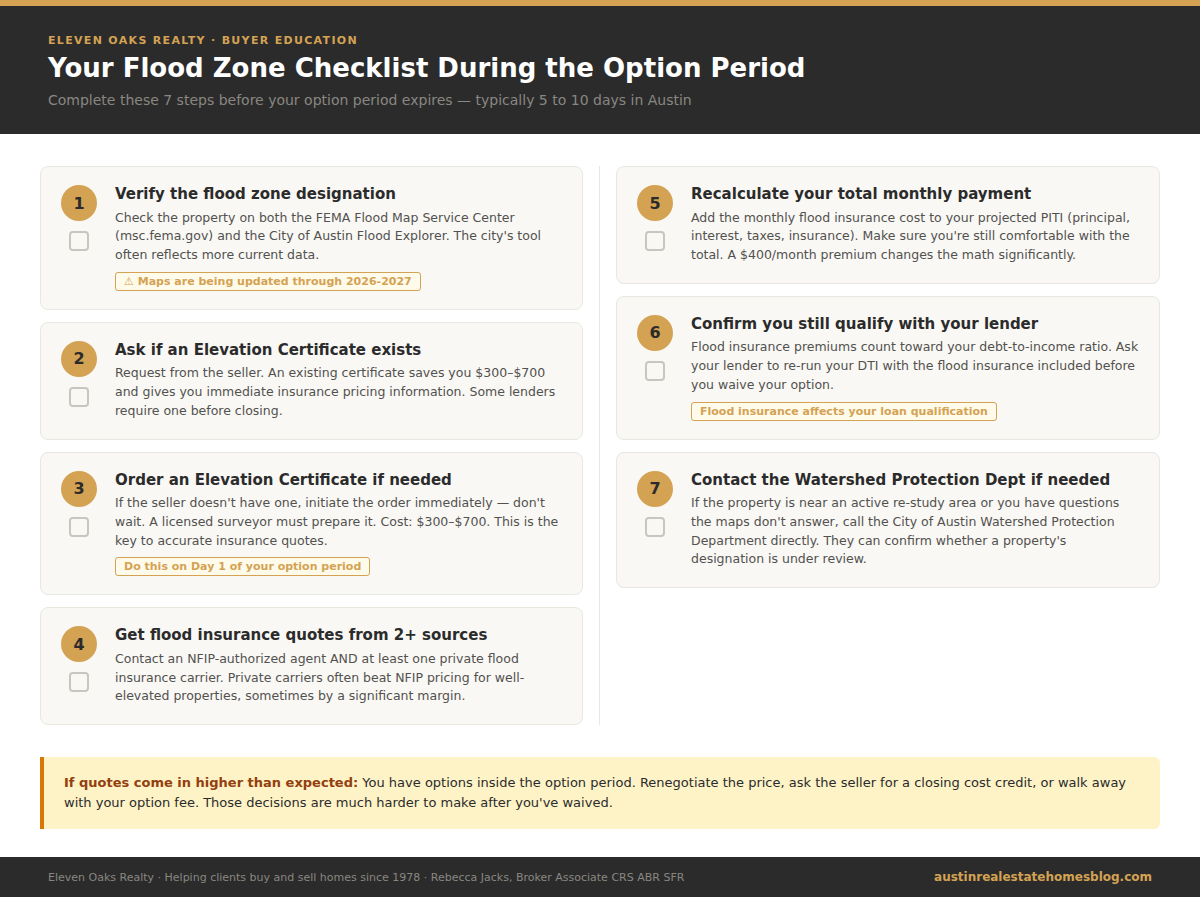
The option period -- typically 5 to 10 days in an Austin purchase contract -- is your window to research flood risk thoroughly. Here's a practical checklist for any home in or near a flood zone:
- Verify the flood zone designation using both the FEMA Flood Map Service Center and Austin Flood Explorer
- Ask the seller whether an Elevation Certificate is on file for the property
- If no certificate exists, order one or initiate the process immediately
- Obtain flood insurance quotes from at least two sources: an NFIP-authorized agent and a private flood insurance carrier
- Add the monthly flood insurance cost to your projected PITI and confirm you're still comfortable with the total payment
- Ask your lender to run your debt-to-income ratio with flood insurance included to confirm you still qualify
- Contact the City of Austin Watershed Protection Department if the property is in an active re-study area or if you have questions the maps don't answer
If the insurance quotes come in higher than expected and change the financial picture meaningfully, you have options: renegotiate the price, ask the seller to contribute a credit toward closing costs, or walk away with your option fee. Those decisions are much easier to make inside the option period than after you've waived it.
Can You Negotiate on a Flood Zone Property?
Yes, and in many cases you should. Flood zone status typically affects market value, and sellers in higher-risk areas often price accordingly. But there's still room to negotiate even after that adjustment.
If a seller doesn't have an Elevation Certificate, requesting that they provide one -- or credit the cost at closing -- is a reasonable ask most sellers will accept. It's a relatively small cost that gives both parties better information.
If a flood insurance quote comes in significantly higher than what the seller's disclosure suggested, you have a legitimate basis to renegotiate the purchase price. Presenting the actual insurance quote in writing gives you a concrete, documented basis for going back to the table.
Some buyers ask sellers to pre-pay the first year of flood insurance as a concession. It doesn't eliminate the ongoing annual cost, but it helps with first-year cash flow and is sometimes agreeable to motivated sellers.
What you cannot negotiate away is the mandatory nature of flood insurance on Zone AE properties with federally-backed loans. That requirement doesn't disappear because the seller says flooding has never occurred. Your lender will verify flood zone status independently, and coverage will be required before closing.
Is Buying in an Austin Flood Zone Worth It?
That depends on the specific property, the price, your financial situation, and your risk tolerance. It's a question worth thinking through carefully rather than answering reflexively in either direction.
Some Zone AE properties in Austin carry genuinely lower actual flood risk than their designation suggests, because they sit on elevated ground within a technical boundary, or because mitigation improvements have reduced risk since the FEMA map was drawn. An Elevation Certificate may show that a home is meaningfully above BFE despite its Zone AE label, which keeps insurance affordable and reduces day-to-day concern.
Others -- particularly those in the Onion Creek corridor or along low-lying stretches of Shoal and Barton Creeks -- have a documented flood history and carry real ongoing exposure. The lessons of July 2025 are a useful reference point: when Central Texas storms hit at their worst, the water can rise fast and with serious consequences.
A few things worth thinking through when evaluating a flood zone purchase:
What does the price reflect? If a home is priced 10 to 15 percent below comparable properties in non-flood-zone areas, that discount may fully account for the added insurance cost. If it's priced at or above market, the numbers may not work in your favor.
What is the resale outlook? Flood zone status can affect your pool of future buyers, particularly as insurance costs have risen and public awareness has grown. Properties with documented flooding histories tend to be harder to sell.
What mitigation exists? Some homes have been elevated, have flood vents installed, or are built on slabs with design features that reduce actual risk despite their FEMA designation. Physical characteristics of the property matter as much as the map label.
Are you comfortable with the uncertainty? Climate researchers note that existing flood maps may still be underestimating actual risk given ongoing atmospheric changes. A Zone X property today could be reclassified Zone AE within your ownership period. That's a real possibility in Austin's evolving risk environment.
These aren't reasons to avoid flood zone properties entirely -- they're reasons to go in with complete information and a clear picture of the ongoing costs.
Frequently Asked Questions About Austin Flood Zones
Flood insurance is mandatory for properties in FEMA Special Flood Hazard Areas (Zone AE, AO, and AH) when the buyer is using a federally-backed mortgage, which includes most conventional, FHA, VA, and USDA loans. Properties in Zone X do not require flood insurance, though it may be a sound optional purchase depending on the specific location and the status of any active re-study in that area.
Start with the FEMA Flood Map Service Center at msc.fema.gov and search the property address. You can also check the City of Austin’s Flood Explorer tool for more current risk data. Keep in mind that Austin’s FEMA maps are currently being revised, so some areas in or near active re-study zones may carry different risk than what current maps show.
Costs vary significantly based on the home’s elevation relative to the Base Flood Elevation. Under NFIP Risk Rating 2.0, Zone AE premiums in Austin currently range from approximately $1,200 to $8,000 or more per year. Private flood insurance can sometimes be less expensive, particularly for well-elevated properties. Get quotes from both NFIP-authorized agents and private carriers before making a final decision.
An Elevation Certificate is a survey document showing how a property’s elevation compares to the Base Flood Elevation set by FEMA. Insurance companies use it to calculate premiums for Zone AE properties. If you’re buying in Zone AE, ask the seller whether one is on file, or order one during your option period for roughly $300 to $700. It can significantly affect what you’ll pay annually for flood insurance.
Yes. Under Texas Senate Bill 339, effective September 2019, sellers must disclose if a property is in a 100-year or 500-year floodplain, near a flood pool or reservoir, or if the property flooded while they owned it. That said, seller disclosure is only as complete as the seller’s own knowledge. Verify flood zone status independently using FEMA’s tools and the Austin Flood Explorer before waiving your option.
Yes, but flood insurance will be required as a condition of your loan if the property is in a Special Flood Hazard Area (Zone AE or similar). Your lender will verify the flood zone designation independently and require proof of flood insurance before closing. The flood insurance premium will be factored into your total monthly payment and your debt-to-income ratio calculation.
Ready to Buy a Home in Austin?
Flood zones don't have to be a deal-breaker, but they do require more due diligence than a typical purchase. Knowing what questions to ask, what to request from the seller, and what numbers to run during your option period puts you in a far better position to make a confident decision.
Eleven Oaks Realty has been helping clients buy and sell homes since 1978, and Rebecca Jacks has been working with Austin buyers since 2007. We know this market, these neighborhoods, and the questions worth asking before you're under contract -- including the ones most buyers don't think to raise until after they've already signed.
If you're looking at homes in Austin and want to talk through flood zone concerns before making an offer, we'd be glad to help. Contact us here to get in touch, or explore our Austin buyer resources for more guidance on the purchase process.




Leave a Reply