

If you are buying a house with a well in the Texas Hill Country, verify five things, in this order: which water source serves the home, whether a groundwater conservation district covers the property, what the well records show, how much water the well produces, and what an accredited lab says about the water. Then fit your inspections into your option period.
Most buyers who have only owned city-water homes do not know what to ask, and that is where costly surprises start. This is a Central Texas checklist, not a national explainer. At Eleven Oaks Realty, helping buyers and sellers since 1978 has meant telling clients the hard parts early, and a well is one of the places where a pretty property can hide real work.
What should you verify first when buying a house with a well?
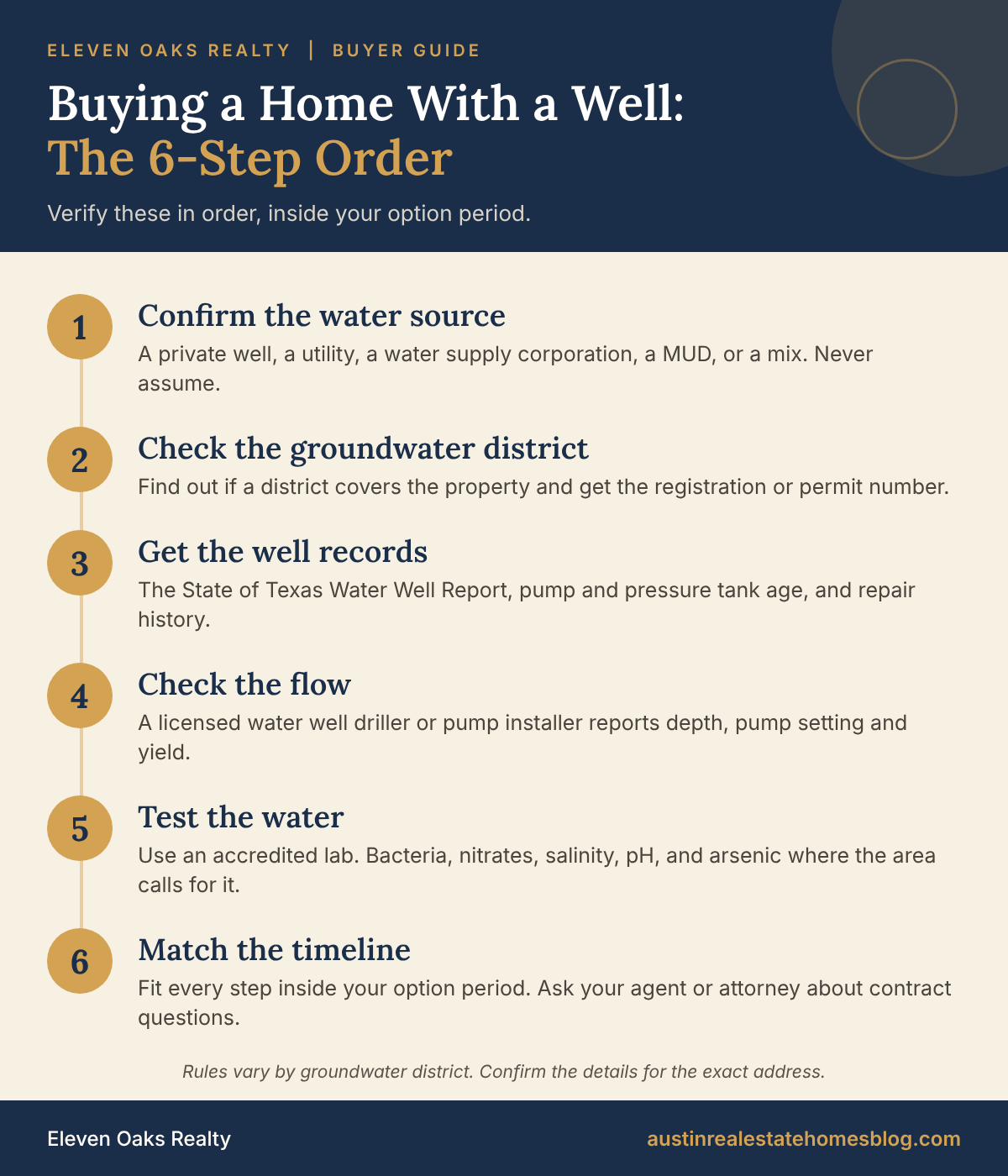
The order matters. A district registration problem or a missing well report can end your interest before you spend money on testing.
- Confirm the water source: a private well, a utility, a water supply corporation, a MUD, or a combination. Never assume.
- Find out if a groundwater conservation district covers the property: and get the well's registration or permit number if one exists.
- Get the well records: the State of Texas Water Well Report, pump and pressure tank details, and any repair history.
- Check the flow: ask a licensed water well driller or pump installer to inspect the well and report on depth, pump setting and yield.
- Test the water: use an accredited lab and know what you are testing for before you collect the sample.
- Match the timeline: schedule all of this inside your option period, with your agent or a real estate attorney reviewing your contract questions.
How do a private well, city water, a water supply corporation and a MUD differ?
A home can use a well, a utility, or both. Some homes have both. Where a city or utility later ran water lines into an established area, some owners kept their wells to water landscaping or fill a pool, so ask whether a well still exists even when the home also has public water. Outbuildings, irrigation and the main house sometimes run on different sources, so confirm each one. If the home sits in a MUD, read my guide to MUDs in the Austin area.
| What to Compare | Private well | City or utility | Water supply corporation or MUD |
|---|---|---|---|
| Who supplies the water | The property’s own well | A city or utility system | A water supply corporation (shown as a co-op on some forms) or a municipal utility district |
| Who maintains the equipment | You, including the pump, pressure tank and wellhead | The provider maintains its lines up to the meter | The provider maintains its lines up to the meter |
| Who is responsible for water quality | You. Texas does not regulate private well water quality | The provider, under public drinking water rules | The provider, under public drinking water rules |
| Ongoing costs | Electricity, repairs, testing, treatment | Monthly water bill | Monthly water bill, and a MUD may add a property tax |
| Ask before you buy | Well report, yield, test results, district rules | Provider name, rates, account history | Provider name, rates, MUD tax rate |
Where in the Austin area do buyers run into wells?
Wells show up most often on acreage and rural-edge properties. Buyers commonly meet them around Dripping Springs, Driftwood, Spicewood, the Bee Cave outskirts, Liberty Hill, Leander and Crystal Falls acreage, Georgetown and Williamson County acreage, and parts of Hays County. Those are general patterns only. One neighborhood may use wells while the next street is on a utility or a MUD, so I confirm the water source address by address.
If you are comparing areas, start with Liberty Hill vs. Driftwood country living and luxury acreage communities near Austin. For north of Austin, see Georgetown neighborhoods with acreage lots, or browse Austin homes on 1-acre lots.
What is a groundwater conservation district, and which ones cover the Austin area?
A groundwater conservation district (GCD) is a local entity that manages groundwater. The Texas Water Development Board says confirmed districts must develop and implement a management plan. Districts can set their own rules for well registration, permits, spacing and production, so the rules for one property can differ from the next county over. Not all land in Texas falls inside a district, and the TREC seller’s disclosure about groundwater and surface water rights asks the seller whether any part of the property does.
To see which district applies, use the TWDB groundwater conservation district map and then confirm with the district. Rules change, so treat what follows as a starting point and verify with the district before you rely on it.
Travis County
Travis County is split. Parts fall inside the Barton Springs/Edwards Aquifer Conservation District, and parts fall inside the Southwestern Travis County Groundwater Conservation District. The district's website states that all wells in its territory must be registered, and that exempt wells (less than 7 gallons per minute, or 10,000 gallons per day) do not need a permit but must meet its well construction standards. The Southwestern Travis County district states that all existing wells in its territory must be registered, and new wells need a drilling authorization application.
Hays County
Hays County is also split. The Hays Trinity Groundwater Conservation District covers Hays County outside the Edwards Aquifer Authority, and its rules also carve out areas inside the Barton Springs/Edwards Aquifer district and the Plum Creek Conservation District. Its rules require all well owners to submit a well registration form. A single-household well is exempt from permits when it cannot produce more than 25,000 gallons per day (17.36 gallons per minute), and spacing requirements grow with pumping capacity. Because several districts touch parts of the county, confirm the exact address with the district before you write an offer.
Williamson County
Georgetown and Williamson County buyers should know that, as of my latest check, I found no groundwater conservation district covering Williamson County. The county government has publicly called for one in a 2023 column from a county commissioner, and a 2024 petition to annex the western part of the county into the Clearwater Underground Water Conservation District was voted down by that district's board on February 14, 2024. Confirm the status for your address on the TWDB map before you rely on this. Where no district applies, you lose a district registration record as a paper trail, which makes the state well report and the seller's disclosure even more important.
Blanco and Burnet Counties
The Blanco-Pedernales Groundwater Conservation District covers Blanco County and requires all wells in the county to be registered. A domestic or livestock well is exempt from an operating permit when it cannot produce more than 25,000 gallons per day (17.36 gallons per minute), and a well capable of more than that needs an operating permit. New wells must also meet the district's spacing rules. In January 2026 the district's board temporarily suspended new non-exempt drilling, operating and transport permit applications until it adopts amended rules. Exempt well registrations, renewals and replacement wells that do not raise production were still being accepted. I could not confirm whether the suspension is still in effect, so call the district before you plan a high-capacity well in Blanco County.
The Central Texas Groundwater Conservation District serves Burnet County. Its website states that district rules require registration of all wells and permitting of certain wells, and that a new well must be registered and receive authorization before drilling begins.
What should you request from the seller?
Ask for these in writing, and ask early:
- The State of Texas Water Well Report: it records when the well was installed, how it was built, total depth and the yield when it was drilled. If the seller does not have it, TWDB explains how to look it up.
- Pump and pressure tank details: age, brand, where the pump is set and any replacements.
- Flow and yield history: any pump tests, and any time the well ran low or dry.
- Water test results: dates and lab names, plus any treatment equipment such as softeners or filters.
- District registration or permit numbers: if the property sits in a district.
- The groundwater and surface water rights disclosure: TREC form 61-0 asks the seller how many wells they know of, how many are in use, and how many are capped, plugged or abandoned.
- Well location: distance from the septic system, property lines and any flood-prone areas.
How do you spot an unregistered or exempt well?
Exempt and unregistered are not the same thing. An exempt well may not need a permit, yet some districts still require it to be registered. Compare the seller's answers with the district's registration records and with the state well report. Walk the property and look for a second wellhead or a capped casing the seller did not mention. The Texas Groundwater Protection Committee warns that you do not want to buy a non-working well, because you may be responsible for having it plugged. You can read its buyer guidance for private water wells.
How do you test well water when buying a home?
The Texas Water Development Board states that Texas does not regulate the water quality of private wells, and that the owner is responsible for fixing problems. Testing is how you learn what you are buying.
What should you test for?
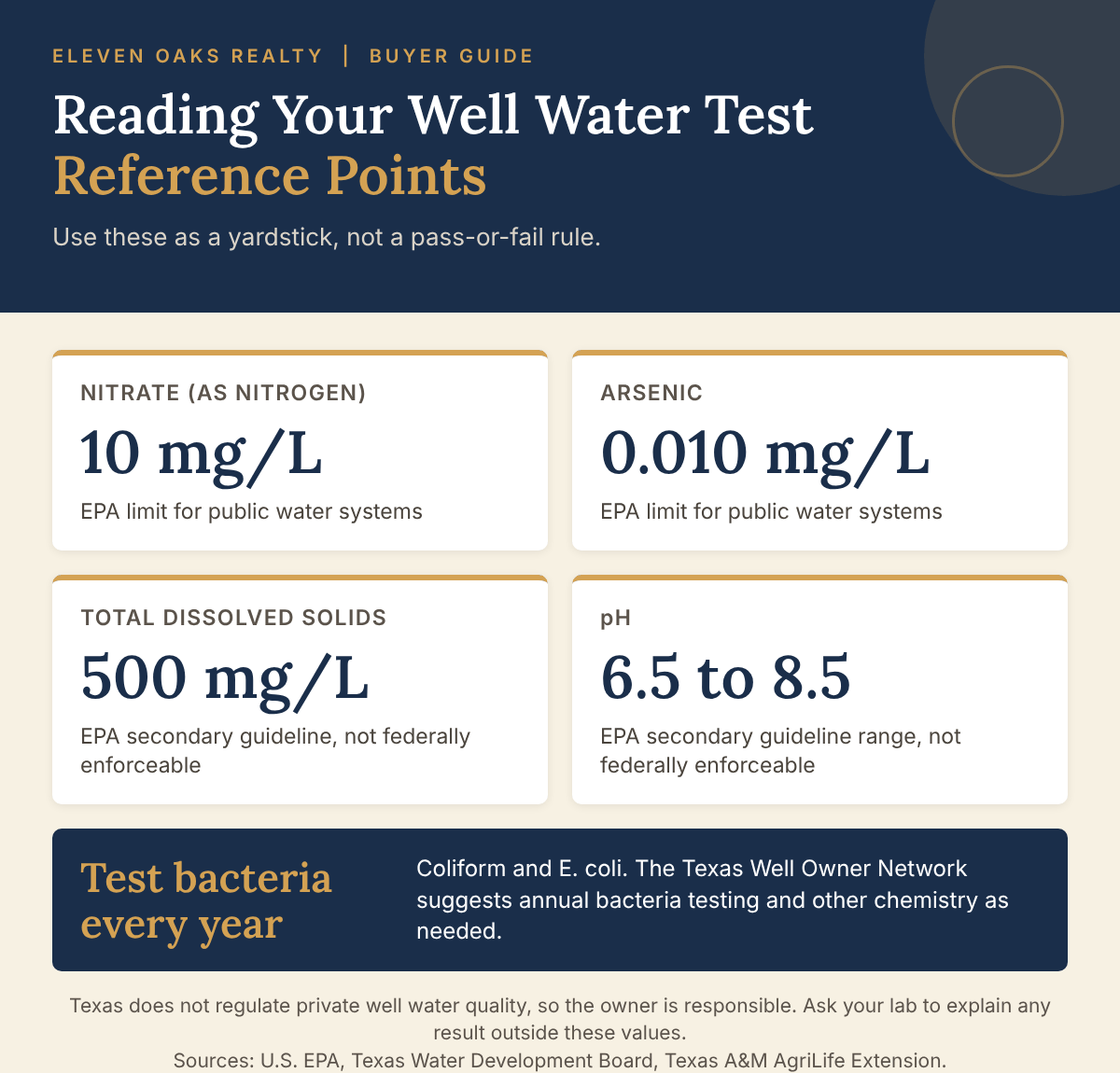
The Texas Well Owner Network, an AgriLife Extension program, screens for coliform bacteria, E. coli, nitrates, salinity or total dissolved solids, pH, and arsenic where the area calls for it. Its guidance is to test for bacteria every year and to test other chemistry as needed. Ask your lab or your district what makes sense for the aquifer under the property.
Who does the testing?
Use a laboratory accredited for drinking water. TCEQ publishes a list of accredited labs, and the TWDB advises calling a lab to confirm its sample drop-off hours and prices. Some groundwater districts test wells for free or at a reduced cost, so ask yours. Collect the sample exactly as the lab instructs.
How do you read the results?
Your lab report will list each result next to a reference value. Federal drinking water standards are a useful yardstick. EPA lists a limit of 10 mg/L for nitrate (as nitrogen) and 0.010 mg/L for arsenic, and secondary guidelines of 500 mg/L for total dissolved solids and a pH range of 6.5 to 8.5. The secondary guidelines are not federally enforceable. A single test is a snapshot, so ask the lab to explain anything that falls outside a reference value, and repeat the test if the numbers surprise you. These federal limits apply to public water systems. EPA notes that private wells are not regulated under the federal Safe Drinking Water Act, so use the numbers as a reference point rather than a pass or fail rule.
How much water does the well actually produce?
Quality is only half of it. Well yield is measured in gallons per minute, and a well that tests clean can still struggle to keep a household supplied. The original well report lists the yield when the well was drilled. That figure can be decades old, so ask a licensed water well driller or pump installer for a current look at depth to water, where the pump is set, and present yield.
Dry stretches matter in Central Texas. Texas A&M AgriLife's well owner guide notes that water tables often drop during severe droughts, which is why the depth where the pump is set matters. Some districts publish drought stages and ask users to cut back. Ask the seller direct questions. Has the well ever run low or dry? Has the pump been replaced or lowered? Has the household ever hauled water? Then compare the answers with what the inspector finds.
Where does the well fit into a Texas purchase and inspection?
Your option period is the window to do this work, so book the specialists the day your contract is signed. Read how earnest money and the option period work and what to expect during a home inspection first. A general home inspection does not replace the specialists.
- Water well driller or pump installer: the Texas Groundwater Protection Committee strongly recommends a licensed driller or pump installer inspect the well.
- Accredited water lab: as described above.
- Septic inspector: if the property also has a septic system, book that inspection too. I cover the basics in our septic system guide.
Contract questions, such as who pays for repairs or what happens if the well fails, belong with your agent or a real estate attorney. I am not giving legal advice here.
What does owning a well cost?
The Texas Water Development Board says a coliform and E. coli bacteria test starts around $20, and a full drinking water standards analysis can reach about $400. Treat both as estimates and ask the lab for a quote.
Pump replacement, pressure tanks, well repair, a new well, treatment systems and annual maintenance all vary by depth, equipment and the contractor. I am not publishing dollar ranges I cannot source. Get written quotes from licensed professionals, and ask the inspector what the equipment's remaining life looks like.
Do wells affect financing and insurance?
They can. The Texas Groundwater Protection Committee notes that most lenders are requiring a well inspection before a purchase can be made. Loan programs differ, so ask your lender what they require, and ask your insurance agent whether anything about the well or its equipment changes your quote, before the end of your option period.
Is rainwater collection a backup for a well?
It can be part of a plan. The TWDB manual on rainwater harvesting says rainwater used for drinking should be tested for pathogens at a minimum, and that treatment generally means filtration and disinfection. It also suggests planning another source, such as a well backup or hauled water. Read the TWDB rainwater harvesting manual, and note that it is an older edition.
What questions should you ask your agent and the seller?
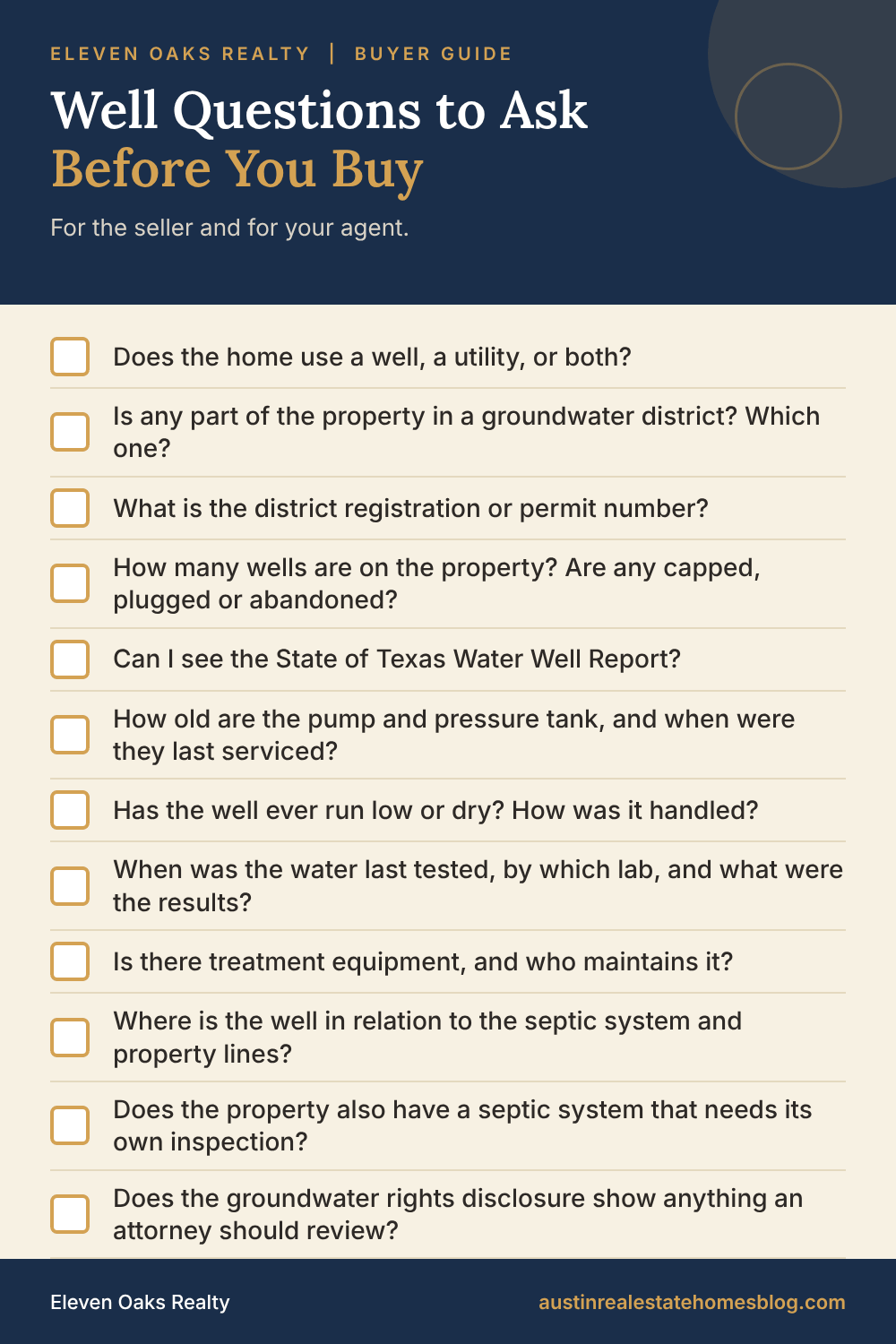
- Does the home use a well, a utility, or both? Which parts of the property use which?
- Is any part of the property in a groundwater conservation district? Which one, and what is the registration or permit number?
- How many wells are on the property, and are any capped, plugged or abandoned?
- Can I see the State of Texas Water Well Report?
- How old are the pump and pressure tank, and when were they last serviced?
- Has the well ever run low or dry, and how was it handled?
- When was the water last tested, by which lab, and what did the results show?
- Is there any water treatment equipment, and who maintains it?
- Where is the well in relation to the septic system and property lines?
- Does the property also have a septic system that needs its own inspection?
- Does the seller's disclosure about groundwater and surface water rights show anything I should have an attorney review?
Frequently asked questions about buying a house with a well
It depends on the property. State law sets a baseline exemption for domestic and livestock wells on tracts over 10 acres that cannot produce more than 25,000 gallons a day, and each district sets its own rules and thresholds. Some districts still require exempt wells to be registered. If no district covers the property, no district rules apply, so confirm the district status for the exact address.
A lab does the testing, and you can use a laboratory accredited for drinking water analysis. TCEQ publishes a list of accredited labs, and some groundwater conservation districts test wells for free or at reduced cost. Call the lab first to confirm it accepts private well samples and how to collect the sample.
The Texas Water Development Board says a coliform and E. coli bacteria test starts around $20 and a full drinking water standards analysis can reach about $400. Labs can usually quote a price before you order a kit.
No. The Texas Water Development Board states that the state does not regulate the water quality of private water wells and that the well owner is responsible for addressing any water quality problems. That is why buyers should test before closing.
Drillers submit a State of Texas Water Well Report when they drill a new well. For wells drilled in 2003 or later, search the TWDB Groundwater Data Viewer or the Submitted Drillers Reports database. For earlier wells, use the TCEQ Water Well Report Viewer. Also ask the seller for their copy.
Texas A&M AgriLife's Texas Well Owner Network suggests testing for bacteria annually and testing for other chemistry as needed, and sooner if the water's color, smell or taste changes.
Often, yes. The Texas Groundwater Protection Committee notes that most lenders are requiring a well inspection before a purchase can be made. Ask your lender early so the inspection fits inside your option period.
Thinking About a Home With a Well? Start With the Right Questions
A well can be a dependable source of water, and it can also become an expensive surprise if nobody checks it first. The best time to bring in an agent is before you start your home search, so the water source, the groundwater district and the inspections shape which homes you look at instead of arriving as an afterthought. We can help you confirm the water source and which groundwater district applies, find the state well report, line up a licensed well inspector and an accredited lab, and fit every step inside your option period. You will get straight answers, including the hard ones.
Prefer to reach out directly? Call or text (512) 827-8323, or email info@11OaksRealty.com.
Eleven Oaks Realty, helping buyers and sellers since 1978.




Leave a Reply